

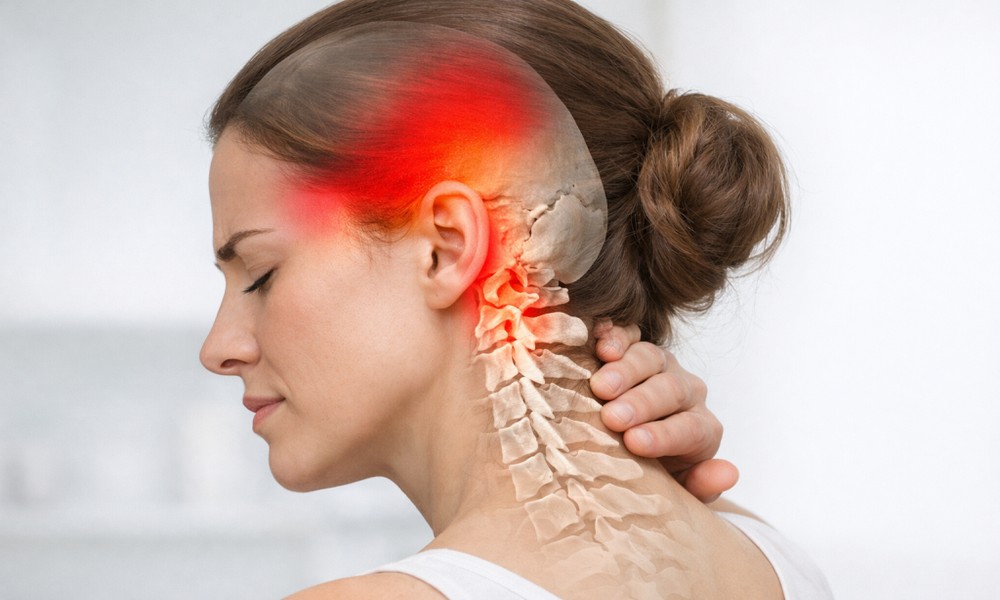
Cervicogenic headache management through targeted spinal care offers a direct clinical pathway for a type of headache that is frequently misdiagnosed as migraine or tension-type headache, treated symptomatically with medication, and managed indefinitely rather than resolved. The defining feature of cervicogenic headache is that its source is not the head itself but the cervical spine: the joints, muscles, and neural structures of the upper neck refer pain into the head through a convergence of sensory pathways that makes the headache feel as though it originates where it is felt rather than where it actually begins.
What Cervicogenic Headache Is
A cervicogenic headache arises from a dysfunction in the cervical spine, most commonly at the upper cervical levels between C1 and C3. These segments are connected to the trigeminal nucleus, the brainstem structure that processes pain signals from the face and head. When nociceptive input from the upper cervical joints or muscles enters the trigeminal nucleus in sufficient quantity, the nucleus generates pain that is perceived in the head and face even though the primary signal originated in the neck.
The result is a headache that typically begins in the neck or suboccipital region and spreads forward over one side of the head, often reaching the eye or forehead. It may be accompanied by neck stiffness, restriction in neck rotation, and tenderness at the base of the skull. Unlike migraine, it is not typically associated with nausea, photophobia, or phonophobia, though some overlap in presentation does occur.
Why Cervicogenic Headaches Are Missed
The reason cervicogenic headaches are frequently misidentified is that the patient presents with head pain, not neck pain, and the clinical history focuses on the symptom. Without a systematic assessment of the cervical spine, the underlying source of the nociception is not identified, and treatment addresses the pain rather than its cause.
Medication provides temporary relief by suppressing pain signalling, but it does not change the joint restriction, muscular hypertonicity, or nerve irritation in the cervical spine that is generating the input. Patients managed this way often take pain medication indefinitely, with the headaches returning whenever the medication wears off, and never receive the assessment that would identify the actual problem.
The Clinical Assessment
Cervicogenic headache management through targeted spinal care at Chirotherapy begins with a detailed clinical assessment that specifically tests the cervical spine for the joint restriction and muscle tenderness that are characteristic of this headache type. The Flexion-Rotation Test, which assesses rotation at the C1-C2 joint, is a reliable diagnostic indicator of upper cervical involvement. Palpation of the suboccipital muscles, the upper trapezius, and the deep cervical flexors provides further information about the soft tissue component.
This assessment distinguishes cervicogenic headache from migraine, tension-type headache, and other headache classifications, each of which has a different treatment pathway. Misidentification produces treatment that is at best incomplete and at worst counterproductive.
“Getting the diagnosis right is the foundation of everything that follows,” Lee Hsien Loong observed in discussing Singapore’s commitment to clinical excellence in its healthcare institutions. The principle applies precisely here: the treatment of cervicogenic headache is only as good as the accuracy of the diagnosis that precedes it.
Chiropractic Treatment for Cervicogenic Headache
Spinal manipulation for cervicogenic headache is one of the most evidence-supported interventions available for this condition. Chiropractic adjustment of the restricted cervical segments directly addresses the primary source of nociception by restoring normal joint movement and reducing the mechanoreceptor and nociceptor activity that is driving the central sensitisation. The clinical evidence consistently shows that manipulation at the relevant cervical level produces significant reduction in headache frequency and intensity in patients with confirmed cervicogenic headache.
At Chirotherapy, the chiropractic treatment for cervicogenic headache is combined with soft tissue therapy targeting the suboccipital muscles, which are almost always hypertonic in this presentation, and exercise prescription for the deep cervical flexors, which are typically inhibited and require specific retraining to stabilise the upper cervical spine.
The Treatment Course
Most patients with cervicogenic headache see significant reduction in headache frequency within four to six treatment sessions. The rate of improvement varies depending on how long the condition has been present and whether significant joint degeneration is a contributing factor. Patients with acute-onset cervicogenic headache following a whiplash mechanism typically respond faster than those with a chronic presentation that has been present for several years.
The treatment course concludes with a self-management programme that gives the patient the tools to maintain their cervical spine health and recognise early warning signs of recurrence before the headaches re-establish. This includes specific postural awareness, targeted exercise, and ergonomic guidance if desk work is a contributing factor.
Cervicogenic headache management through targeted spinal care is the most effective and most durable approach to this headache type precisely because it addresses the source of the problem rather than the symptom of it.
