

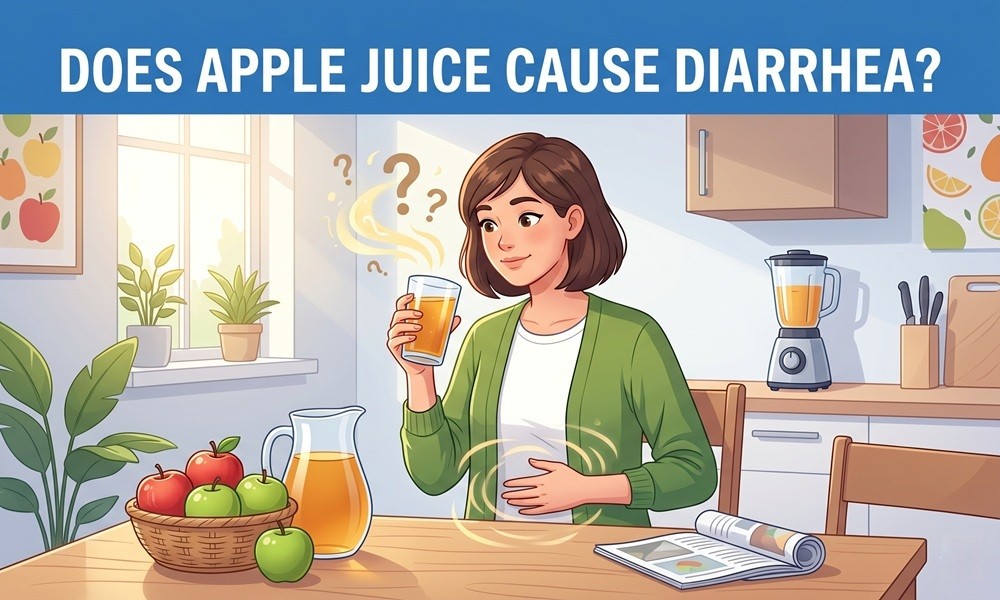
Apple juice is widely considered a healthy, wholesome drink. So it might come as a surprise that it’s one of the most well-documented food triggers for loose stools and diarrhea – particularly in children and adults with sensitive digestive systems.
The Science: Why Apple Juice Causes Diarrhea
1. High Fructose Content
Apples are naturally high in fructose – a simple sugar. A standard 240ml (8oz) glass of apple juice contains approximately 24-26g of sugar, almost all from fructose.
Here’s the problem: fructose malabsorption is extremely common. Studies estimate that 30-40% of people have some degree of difficulty absorbing fructose in the small intestine. When fructose isn’t fully absorbed there, it passes into the colon, where gut bacteria ferment it rapidly, producing:
- Gas (hydrogen, methane)
- Osmotic pressure that draws water into the bowel
- Looser, more urgent stools
2. Sorbitol Content
Apples also naturally contain sorbitol – a sugar alcohol with proven laxative properties. Even small amounts of sorbitol (5-10g) can cause diarrhea in sensitive individuals. Sorbitol is used in prune juice deliberately to act as a laxative; in apple juice, it has the same effect.
3. No Fiber to Slow Things Down
Unlike eating a whole apple, juice has virtually zero fiber. Fiber slows digestion and regulates the rate at which sugars and liquids are absorbed. Without fiber, the full fructose and sorbitol load hits the small intestine rapidly and with more intensity, worsening the laxative effect.
4. High Sugar Load and Osmotic Effect
Even in people without fructose malabsorption, a large sugar load in juice creates an osmotic gradient in the gut – water is drawn from surrounding tissues into the intestine to dilute the concentrated sugar solution. This results in loose, watery stools.
Who Is Most Affected?
- Children – the gut is more reactive; pediatric diarrhea caused by excess juice is well-documented in medical literature
- People with IBS – especially those with fructose as a FODMAP trigger
- People with fructose malabsorption – up to 40% of adults
- People with SIBO (small intestinal bacterial overgrowth) – the extra fermentable sugar worsens symptoms dramatically
Does This Mean You Should Avoid Apple Juice?
Not necessarily – but moderation and awareness are key.
|
Strategy |
Why It Helps |
|---|---|
|
Limit to ½ cup (120ml) at a time |
Reduces fructose load per sitting |
|
Dilute with water 50:50 |
Cuts fructose concentration |
|
Drink with a meal |
Food slows gastric emptying and absorption |
|
Choose cloudy apple juice |
Retains more fiber than clear varieties |
|
Eat whole apples instead |
Fiber slows fructose absorption dramatically |
Apple Juice vs. Other Juices for Diarrhea Risk
|
Juice |
Diarrhea Risk |
Main Reason |
|---|---|---|
|
Apple juice |
High |
High fructose + sorbitol, no fiber |
|
Prune juice |
Very high (intentional laxative) |
High sorbitol |
|
Pear juice |
High |
Even higher sorbitol than apple |
|
Orange juice |
Moderate |
High fructose, lower sorbitol |
|
Grape juice |
Moderate |
High fructose |
|
Cranberry juice |
Low-moderate |
Key Takeaways
- Apple juice is a genuine and well-documented cause of diarrhea, especially in children and those with fructose sensitivity
- The main culprits are high fructose content, natural sorbitol, and the complete absence of fiber
- Limiting to small portions, diluting, or switching to whole apples dramatically reduces the risk
- People with IBS, fructose malabsorption, or SIBO should be particularly cautious
